https://linktr.ee/misssarahwise
Introducing my latest book
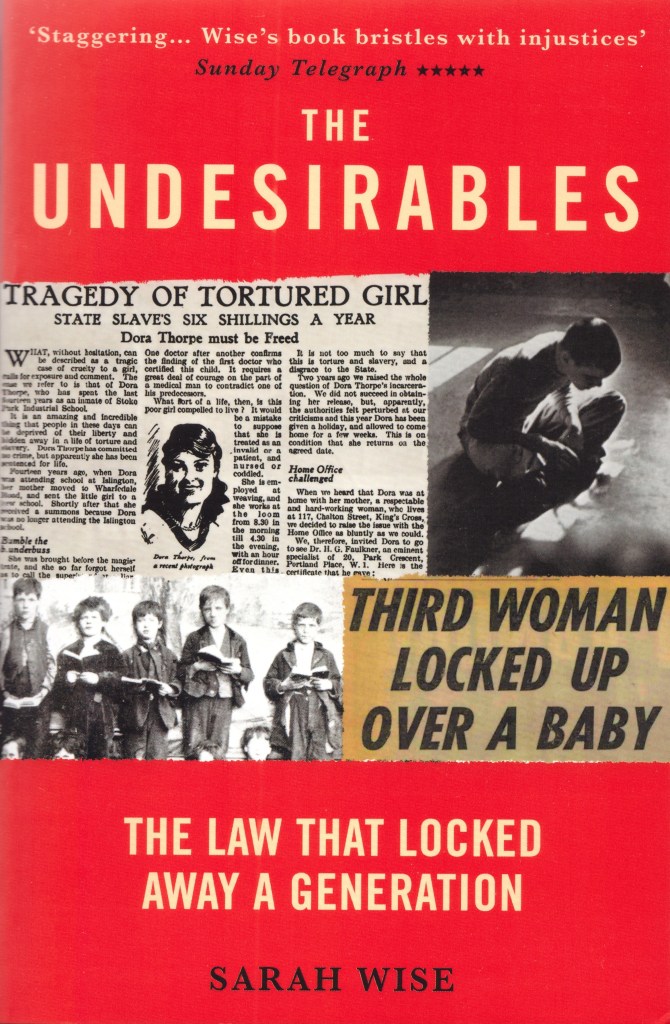
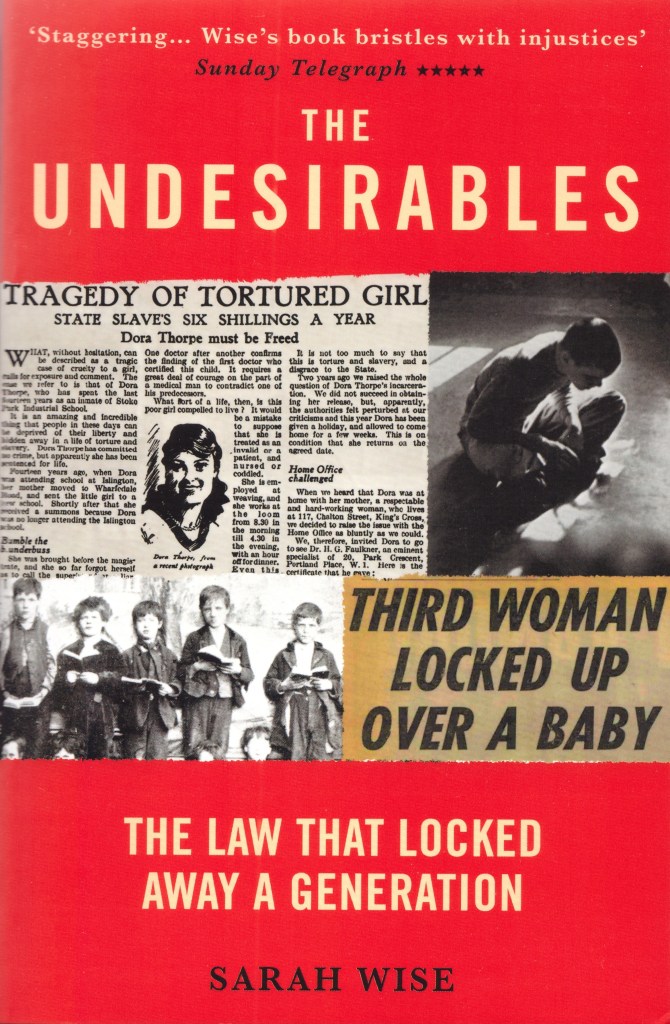
Published in paperback by Oneworld, 2025 https://shorturl.at/e36iB
‘Staggering… Wise’s book bristles with injustices.’ 5 stars,
Sunday Telegraph
‘An important, shocking book.’ The Independent
‘With her usual panache, Wise manages to find humanity in the darkest places and tells an important story with understanding and wit.’ Emily Cockayne, Book of the Year, History Today
‘A shocking study.’ The Times
‘The government has never offered an apology to the thousands detained. This powerful book might offer a step in that direction.’ Times Literary Supplement
‘A gruelling but important book. Wise has uncovered a forgotten and terrible scandal of the not-so-distant past.’ Literary Review
‘Compelling. . . The Undesirables advances our knowledge of this shameful episode in leaps and bounds:’ History Today
‘A harrowing tale, extremely well told.’ The Tablet, Catholic weekly magazine

Interviews
I spoke with Jess Cale of the Dirty, Sexy, History podcast shorturl.at/4gAFa
And at the Wanstead Tap, east London, with Dan Clapton The Tap Into Podcast…Live – Hosted by dan clapton (acast.com)
On @portobelloradio.com I spoke to Aidan McManus/ Flipside Tours about my first book, The Italian Boy, as well as The Undesirables, here: https://www.mixcloud.com/aidan-mcmanus/flipsidelondon-radio-episode-147-with-historian-and-author-sarah-wise/ This was my desert island opportunity – I chose 5 tracks that conjure up visions of London for me
My other books
I am a Victorianist making her first foray into 20th century social history. My first three books of 19th century history are…
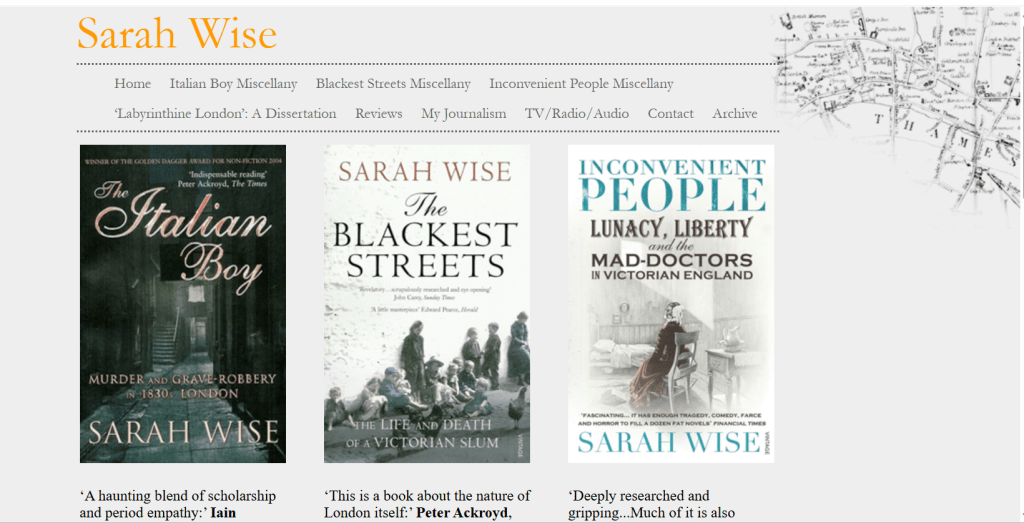
John Carey‘s review of The Blackest Streets for the Sunday Times is here: The Blackest Streets: The Life and Death of a Victorian Slum by Sarah Wise
I recorded this short piece about The Italian Boy for the In Depth Pet Shop Boys podcast just before Christmas — they wrote a song about it https://podcasts.apple.com/gb/podcast/12fl001-sarah-wise-the-resurrectionist/id1687461770?i=1000739765217
I gave this talk at the Edinburgh Festival about Inconvenient People — at the Royal College of Physicians of Edinburgh: Sarah Wise – Gaslight Stories: Women in White, Eccentric Heirs, Inconvenient People
About me
I have a Masters in Victorian Studies (history and literature joint honours) from Birkbeck College, University of London, and a BA in English Literature. I teach undergraduates of the University of California at their London Outreach Study Centre; and I work in adult education in London at the City Lit, Mary Ward Centre and the Highgate Literary & Scientific Institution.
I was on Lucy Worsley Investigates, speaking about the Whitechapel of Jack the Ripper https://www.bbc.co.uk/programmes/m0025ntd
And I spoke on BBC Radio 4’s In Our Time about the life and work (and Poverty Map) of Charles Booth https://www.bbc.co.uk/programmes/m000wsxf
You can find me on BlueSky: misssarahwise.bsky.social
And on Twitter / X: @misssarahwise
About The Undesirables
My last book, Inconvenient People, concerned the scandal of Victorians being placed into ‘lunatic’ asylums on very little evidence. It ended with a mention of how, in fact, wrongful detention became a far bigger and more intractable problem in the 20th century. The reviewer for The Independent noted this upsetting ending: ‘After these cheerful late cases comes a devastating epilogue… You put this quite superlative book down, shaken.’
The Undesirables picks up the story, from circa 1900, and is something of a follow-up to Inconvenient People – it is my attempt to reveal how 20th-century policy played out on the ground, in institutions, towns, villages, communities and home life.
This type of persistent misbehaviour was believed by many experts to be an inherited condition. And so the Mental Deficiency Act deemed that ‘moral imbeciles’ must not breed – the institutions they were sent to were sex-segregated for this purpose.
The 1913 Mental Deficiency Act created two new categories, ‘the feeble minded’ and ‘the moral imbecile’. The legislation describes the latter as ‘persons who from an early age display some mental defect coupled with strange, vicious or criminal propensities on which punishment has little or no deterrent effect’. In reality, it led to the scooping up, labelling and institutionalisation of many working-class youngsters who simply didn’t fit in, or who were passing through a perfectly normal time of adolescent rebellion.
This form of preventive detention – for life – had no precedent in England. And it was the closest Britain came to implementing eugenically inspired policy.
The most infamously mislabelled of these people were young unmarried women who found themselves pregnant. But the law impacted on young males, too – those who would not or could not settle down, those who were persistent thieves, vandals, truants or who were sexually out of control. Even the man who ran Rampton admitted that the Mental Deficiency Act impacted on those who had ‘failed to adjust themselves to the social conditions in which they live.’
When the great opening up of the UK’s mental hospitals got under way, from the 1960s onwards, thousands of people, now in their sixties, seventies or eighties, were discovered languishing on the ‘back wards’, having spent their entire adult life in mental institutions, for no reason at all. It was a catastrophic waste of lives, for no good reason at all.
There is a general misconception that they had been ‘put away’ as a result of Victorian attitudes to morality and behaviour. With The Undesirables, I hope to show that this was very much a 20th-century piece of nastiness, piecing together fragments of the experiences of those who underwent such detention.
MAKING CONTACT For telly or any business requests, please contact my agent, Sarah Chalfant, at The Wylie Agency (mail@wylieagency.co.uk)
Or you can get in touch direct, here


My teaching
At the City Lit, the Mary Ward Centre and the Highgate Lit & Sci I teach a number of social history and literature courses. Coming up this autumn/winter:
- Borderlines of Madness in 19th Century Fiction, 7-week course at the City Lit, 30 January 2026 to 13 March. Booking here: https://www.citylit.ac.uk/courses/borderlines-of-madness-in-19th-century-fiction
- An Introduction to Mental Health History of the 19th and Early 20th Century, study day, Saturday 7 February, at City Lit. We will explore the various diagnoses and altered states of consciousness that 19th and early 20th century doctors devised. In addition, we will take a look at the administration of ‘lunacy’ law, with particular reference to the private and public asylums in and around the London area. Booking here: An introduction to the history of 19th & early 20th century mental health | Culture, history & humanities course | London | City Lit
- WALK: Victorian Soho: Sex and Shopping, Anarchy and Tourism, 11am Wednesday, 18 February. 2 hours. The West End was a heady mix of glamorous shopping emporia, political refugees from Europe, street-based and brothel-based prostitution, and the general public just enjoying a day or evening ‘Up West’. Booking: Victorian Soho: Sex and Shopping, Anarchy and Tourism | Culture, history & humanities course | London | City Lit
- Introduction to Charles Booth’s London, 5 May 2026 to 9 June, six week online course, City Lit. Details: https://www.citylit.ac.uk/courses/introduction-to-charles-booths-london/hlw200-2526
- Apocalypse London: the City in Dystopian Fiction, 1880-1974, 6-week course at the City Lit, 15 May 2026 to 19 June. Details: https://www.citylit.ac.uk/courses/apocalypse-london-the-city-in-dystopian-fiction-1880-1974/hlt301-2526
Most recent short writing/chapters
I contributed a chapter about Charles Booth’s influence on late-19th-century fiction to Critical Essays on Arthur Morrison and the East End, edited by Diana Maltz (Routledge) https://www.routledge.com/Critical-Essays-on-Arthur-Morrison-and-the-East-End/Maltz/p/book/9781032276762
I wrote the chapter on ‘Morality’ in the LSE / Thames & Hudson book Charles Booth’s London Poverty Maps Charles Booth’s London Poverty Maps (thamesandhudson.com)
I investigated the mysterious Grace Poole in Jane Eyre in Hektoen International, Journal of Medical Humanities Why “nurse” Grace Poole is the greatest puzzle in Jane Eyre – Hektoen International (hekint.org)
Dr Isaac Baker Brown and female genital mutilation in Victorian London in History Today Removing That Little Knot | History Today
‘Povertyopolis: Beyond the East-West Binary in the Late-Nineteenth-Century London Literary Imagination’ in The London Journal Povertyopolis: Beyond the East-West Binary in the Late-Nineteenth-Century London Literary Imagination: The London Journal: Vol 46 , No 3 – Get Access (tandfonline.com)
I contributed ‘The Stolen Chapter: James Timewell’s Challenge to the Metropolitan Police’ to Rebellious Writing: Contesting Marginalisation in Edwardian Britain (edited by Lauren Alex O’Hagan) Rebellious Writing – Peter Lang Verlag
I have three articles on the London Fictions website, on Joseph Conrad, George Orwell and Arthur Morrison Joseph Conrad: The Secret Agent – London Fictions
Most recent telly, radio, podcast appearances
Bad Women podcast, speaking about late-Victorian East London, series 1, episode 3, ‘Polly Walks Out’ S1 E3: Polly Walks Out – Bad Women: The Blackout Ripper (podcast) | Listen Notes
BBC Radio 4 podcast series Killing Victoria, discussing the insanity defence in 19th-century murder trials https://www.bbc.co.uk/programmes/p0dtcddd
BBC Radio 3 Free Thinking, episode on the streets of Victorian London BBC Radio 4 – Free Thinking, Victorian Streets
BBC Radio 4, In Our Time, discussing Charles Booth‘s Life and Labour of the People in London BBC Radio 4 – In Our Time, Booth’s Life and Labour Survey
BBC2, The Real Peaky Blinders, documentary exploring the London origins of the racetrack villains BBC Two – The Real Peaky Blinders, Series 1, Episode 2
Peter Moore’s Travels Through Time history podcast series, the year 1889 The Blackest Streets of London, 1889 (podcast) | Travels Through Time (tttpodcast.com)
 Sarah Wise, Historian, author, tutor